


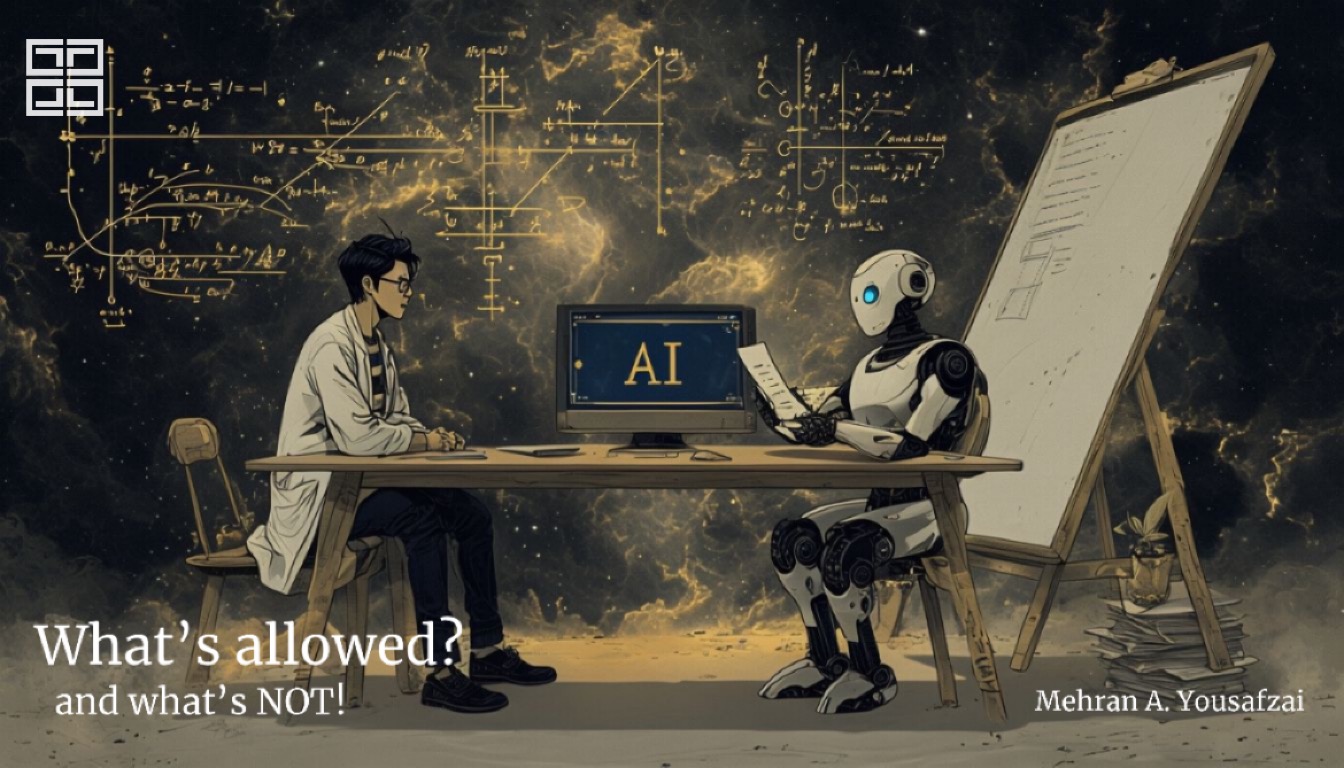
Commentary on Taylor & Francis’ AI Policy
The rise of generative artificial intelligence (AI) has brought both opportunities and challenges to academic research and publishing. AI-powered tools can enhance productivity, assist with language refinement, and streamline literature reviews. However, their use also introduces risks related to misinformation, ethical concerns, and academic integrity.
Taylor & Francis Group has introduced a comprehensive AI policy to guide researchers, authors, editors, and reviewers on the responsible use of AI in scholarly work. This commentary critically examines the key aspects of the policy and highlights its strengths and potential areas for refinement
1.Opportunities & Risks
AI has the potential to significantly aid researchers by automating routine tasks such as organizing references, refining language, and even assisting with data analysis. For example, AI-driven grammar checkers like Grammarly or DeepL Write can help non-native English speakers improve the readability of their manuscripts. Similarly, tools like OpenAI’s ChatGPT or Elicit can summarize large bodies of research, making literature reviews more efficient.
However, Taylor & Francis rightly identifies several risks associated with AI use:
- Inaccuracy and Bias: AI models, including large language models (LLMs), generate text based on probabilistic predictions rather than factual reasoning. As a result, they may produce misleading or factually incorrect statements. For instance, AI might fabricate citations or misinterpret research findings which may lead to the propagation of misinformation.
- Lack of Proper Attribution: AI does not inherently provide sources for the information it generates, which raises concerns about traceability and intellectual property. Unlike human researchers who cite original studies, AI-generated content often lacks verifiable references.
- Data Privacy and Intellectual Property Risks: Many AI platforms are cloud-based, meaning that any data inputted into them may be stored, analyzed, or even used for further AI training. For instance, researchers uploading unpublished manuscripts into AI tools may unintentionally expose their work to external parties.
- Unintended Use and Ethical Concerns: AI providers may use user-generated content for improving their models. This raises ethical questions about consent and data ownership. Researchers must be cautious when inputting confidential information into AI tools.
2.Guidelines for Authors
2.1. Accountability & Ethical Responsibility
Taylor & Francis makes it clear that authors remain fully responsible for the integrity, originality, and accuracy of their submissions, even when AI tools are used. While AI can support research, it cannot replace human judgment and ethical accountability.
Authors are advised to verify all AI-generated content before submission. Some journals may permit AI use only for language enhancement, while others may require explicit approval for more extensive applications, such as data analysis or literature summarization.
2.2. Authorship & Attribution
AI tools cannot be credited as authors because they lack accountability, legal responsibility, and the ability to consent to authorship agreements. The policy aligns with COPE (Committee on Publication Ethics) guidelines, which emphasize that authorship requires intellectual contribution and responsibility—qualities AI lacks
Authors must explicitly disclose AI usage, including:
- The name and version of the AI tool used (e.g., ChatGPT-4, Grammarly Premium, Elicit AI).
- The specific role AI played in the research (e.g., language refinement, literature classification, statistical coding assistance).
- The reason for using AI (e.g., improving clarity in a non-native language manuscript).
For journal articles, these disclosures should be included in the Methods or Acknowledgments section. In book publications, authors should inform their editors and place disclosures in the Preface or Introduction to ensure transparency.
2.3. Prohibited Uses
The policy explicitly restricts certain AI applications in academic writing. Failure to adhere to these guidelines may result in editorial investigations or even retraction of published work.
Restrictions on Visuals: The policy prohibits the use of AI-generated images, figures, or research data in scholarly publications. The policy applies to: i) Research figures, graphs, and data tables, ii) AI-generated or AI-modified medical images, such as scans or histological samples, and iii) Any manipulation of existing images that alters scientific meaning. This restriction aims to prevent scientific misrepresentation and maintain the authenticity of visual content.
Unverified AI-generated Text or Code: AI-generated content should never be submitted without thorough human review and verification. For example, using AI to draft a research conclusion without validation can lead to misleading interpretations.
Replacement of Missing Data with AI-generated Data: AI cannot be used to fabricate or substitute experimental data. If real-world data is incomplete, researchers must acknowledge the limitations rather than filling gaps with AI-generated estimates.
Generating Abstracts Without Verification: AI-generated abstracts may misrepresent research findings if not carefully scrutinized. A common issue is AI introducing bias by overemphasizing certain aspects of a study while neglecting others.
3.Guidelines for Editors & Peer Reviewers
Editors and peer reviewers play a crucial role in safeguarding research integrity. The policy strictly prohibits them from uploading unpublished manuscripts, images, or confidential data into AI tools. This measure prevents potential breaches of intellectual property rights and ensures confidentiality during the peer review process. The restriction is essential for several reasons:
- Confidentiality Breaches: AI tools operating on cloud-based systems could expose confidential research findings to external parties, risking intellectual property theft.
- Loss of Analytical Rigor: AI-generated summaries might fail to capture nuanced arguments and critical assessments that require expert human judgment.
- Potential for Bias: AI tools may emphasize certain aspects of a study while neglecting others, leading to skewed evaluations.
- Undermining the Peer Review Ethos: Relying on AI-generated critiques instead of independent analysis could compromise scholarly standards.
For example, an AI-generated summary of a research paper on climate change policy might highlight statistical trends while neglecting qualitative discussions on political or ethical implications, leading to an incomplete review.
The policy acknowledges that AI technology is evolving rapidly and commits to continuous updates based on emerging research ethics standards. Researchers, editors, and reviewers must stay informed about future revisions to maintain compliance.
4.Conclusion
Taylor & Francis’ AI policy offers a well-structured framework for integrating AI responsibly into academic publishing. By emphasizing accountability, transparency, and ethical considerations, the policy ensures that research integrity is upheld while still enabling authors to benefit from AI’s capabilities. Its guidelines set clear boundaries for appropriate AI use, reinforcing human oversight and ethical responsibility in scholarly work. This balanced approach helps researchers navigate the evolving AI landscape while safeguarding academic credibility and trust.
5.Potential Refinements
The policy acknowledges that AI technology is evolving rapidly and commits to continuous updates based on emerging research ethics standards. Researchers, editors, and reviewers must stay informed about future revisions to maintain compliance. Potential areas for refinement in the Taylor & Francis AI policy could include:
- Clarification on AI’s Role in Research Methodology: While the policy outlines AI’s use in writing and data visualization, it does not extensively address AI-driven data analysis or machine learning applications in research. Some disciplines, such as computational biology, materials science, and social sciences, rely on AI to identify patterns and generate predictive models. More detailed guidelines on AI’s role in these contexts could help researchers navigate its appropriate use.
- Granular Disclosure Requirements: The policy mandates AI usage disclosure but does not specify the level of detail required. Should authors disclose all interactions with AI tools, or only those that significantly impact the manuscript? A standardized reporting framework, similar to PRISMA for systematic reviews, could enhance transparency.
- AI Use in Data Interpretation: The policy prohibits AI-generated data but does not explicitly address AI-assisted data interpretation. AI tools like MATLAB AI and IBM Watson can process large datasets, and researchers might rely on them for advanced analytics. Clear guidelines distinguishing AI-assisted interpretation from AI-generated findings could prevent potential misrepresentation of data.
- Allowing Verified AI-Generated Figures in Certain Contexts: While the policy bans AI-generated visuals, it could consider exceptions where AI-generated images are integral to research, such as deep-learning-generated medical scans in radiology or AI processed satellite imagery in geoscience. Implementing a verification protocol, where AI-generated visuals are accompanied by raw data and validation steps, could ensure their credibility.
- Guidance for AI’s Role in Peer Review Efficiency: The complete prohibition of AI in peer review may overlook AI’s potential to improve efficiency, such as summarizing reviewer reports or flagging potential conflicts of interest. If used with strict oversight, AI could assist in administrative tasks without replacing human judgment.
Disclaimer
This commentary is intended for educational and informational purposes only. It provides an analysis of the Taylor & Francis AI policy based on publicly available information and general academic guidelines. The commentary does not serve as a replacement for the original policy issued by Taylor & Francis. Readers are strongly encouraged to refer to the official policy and/or any related documentation for authoritative guidance on AI usage in academic writing. Any interpretations or recommendations presented here should be considered supplementary and not legally binding. Learn more
About the Author
Mehran A. Yousafzai is a researcher at School of Civil Engineering, Southeast University and a member of the Board of Governors at UNIT313.
 We Stand With