


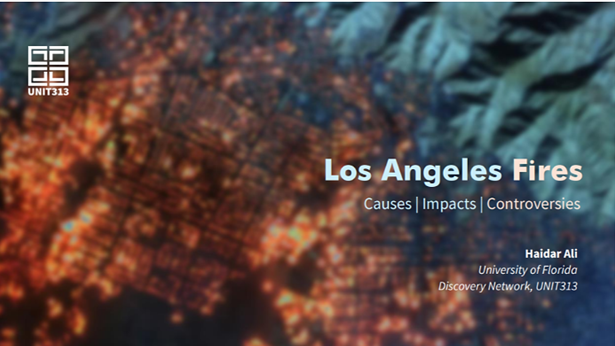
On the Los Angeles Wildfires: Causes, Impacts and Controversies
A major chapter in the history of the city has been marked by the immense devastation caused by the recent wildfires in Los Angeles, which began on January 7, 2025.
1.Historical Context
Wildfires have long plagued Los Angeles, with several major incidents highlighting the city’s vulnerability:
1.1. Bel Air Fire (1961)
A wake-up call for urban planners concerns fire safety along wild land-urban interfaces, this fire destroyed 484 homes in a wealthy area (California Department of Forestry and Fire Protection, 1961).
1.2. Cedar Fire (2003)
This was the biggest wildfire in California history at the time. It killed 15 people, damaged around 2,800 buildings, and burned 280,000 acres (National Interagency Fire Center, 2003).
1.3. Thomas Fire (2017)
The Thomas Fire, one of the most destructive disasters in recent history, destroyed 1,063 houses, burned over 281,000 acres, and forced tens of thousands of people to evacuate (California Fire Authority, 2017).
Causes
University researchers interact with peers, attend research meetings, and engage in collaborations. Independent researchers must actively seek such connections through online communities or conferences.
Example: A university student researching AI ethics might have weekly discussions with their research group, while an independent researcher would need to find AI ethics groups on platforms like LinkedIn or ResearchGate.
Despite these challenges, independent research can be rewarding. Let’s explore some effective approaches.
2.1. Climate Change
Wildfire frequency and intensity have dramatically increased as a result of human-induced climate change-induced global warming. Long-term drought conditions in California have resulted in dry vegetation that serves as fire fuel (Wang et al., 2024). Higher temperatures are drying up forests and grasslands at an alarming rate, according to studies, and the region’s fire season is now longer and more intense (IPCC Report, 2022).
2.2. Santa Ana Winds
The hot, dry, and windy Santa Ana winds are well-known for drying out vegetation and dispersing embers across great areas. These gusts, which can reach 50–70 mph, quickly enlarge the boundaries of wildfires and make battling them extremely difficult. Additionally, the winds transport debris and smoke, which exacerbates public health problems and air quality (California Fire Authority, 2023).
2.3. Human Activities
Human activities, such as abandoned cigarettes, unattended campfires, and electrical infrastructure failures, are directly or indirectly responsible for a sizable portion of California’s wildfires. According to earlier wildfire investigations, arson instances also play a major role in the disaster (Smith & Johnson, 2025). The hazards are increased by poor urban design, such as constructing residences next to combustible wild-land regions.
Impacts
The aftermath of these wildfires extends beyond the immediate destruction, leaving a lasting scar on communities and ecosystems:
3.1. Property and Life Losses
Thousands of people have been forced to relocate as entire neighborhoods have been devastated. Although there have been at least 25 confirmed deaths, more are anticipated as recovery efforts proceed (Los Angeles Times, 2025). Families are now homeless and infrastructure is severely damaged as more than 5,000 buildings, including houses, businesses, and schools, have been destroyed.
3.2. Economic Damage
One of the most costly natural disasters in American history, the flames could cost more than $250 billion. This amount covers property damage, lost income, agricultural losses, firefighting costs, and economic disruption in the travel and business industries (Financial Times, 2025).
3.3. Environmental Degradation
Thousands of acres of parklands and forest, including famous places like Griffith Park, have been completely destroyed by fire. Local ecosystems have been impacted by the destruction of wildlife habitats. A vicious cycle is created by the carbon emissions from these flames, which also fuel global warming (The Atlantic, 2025).
Conspiracies
The chaos surrounding wildfires often breeds misinformation, with various myths and conspiracy theories gaining traction:
4.1. Directed Energy Weapons
According to a persistent conspiracy theory, the flames were purposefully started using sophisticated laser technologies. Experts and researchers, however, have refuted this assertion on numerous occasions, pointing to human and natural reasons in their place (Fletcher, 2025).
4.2. Government Land Grabs
Some people think that wildfires are sparked on purpose to make way for government or commercial development initiatives. Investigations, however, have shown up no proof for these assertions (Brown, 2025).
4.3. Denial of Climate Change
Some parties ignore the impact of climate change and blame wildfires only on inadequate forest management. Although forest management plays a part, scientists agree that shifting weather patterns and rising global temperatures play a major influence (Smith et al., 2025).
Conclusion
Wildfires in January 2025 serve as a sobering reminder of the problems brought on by urbanization, climate change, and poor environmental management. A multimodal strategyincluding community readiness, enhanced firefighting infrastructure, regulatory reforms, and a dedication to sustainable practices is needed to combat this expanding threat. Such catastrophes will worsen and put lives, ecosystems, and economies in jeopardy if nothing is done.
References
- California Department of Forestry and Fire Protection. (1961). The Bel Air Fire Report.
- California Fire Authority. (2023). Santa Ana Winds and Fire Risks.
- Financial Times. (2025). “Wildfire Costs: An Unprecedented Economic Impact.”
- Fletcher, T. (2025). Debunking Wildfire Conspiracy Theories.
- Intergovernmental Panel on Climate Change (IPCC). (2022). Climate Change and Extreme Weather Events.
- Los Angeles Times. (2025). “January 2025 Wildfires: Damage and Recovery.”
- National Interagency Fire Center. (2003). The Cedar Fire Incident.
- Smith, J., & Johnson, P. (2025). “Human Factors in Los Angeles Wildfires.”
- The Atlantic. (2025). Wildfire Impact on California’s Natural Landscape.
- Wang, Z., et al. (2024). Climate Change and Wildfire Trends in California.
Disclaimer
The views and opinions expressed in this article are those of the author and/or the resources cited, if any, and do not necessarily reflect the position of UNIT313.
About the Author
Haider Ali is a researcher at the University of Florida, United States, and an advisor to the Discovery Network by UNIT3

 We Stand With